googlef87758e9b6df9bec.html A Sure Word

Saturday, November 8, 2008

Dinosaur Dance Floor

“In this undated photo released by the University of Utah, geologist Winston Seiler poses next a trackway, or set of prints made by the same dinosaur, as it walked through a wet, sandy oasis some 190 million years ago.”
Wow, 190 million year old footprints! That sounds impressive. When scientists first found these tracks in the Coyote Buttes North area straddling the Utah-Arizona border, they called the area a “dinosaur dance floor.” They believed they had found as many as 1,000 tracks of previously unidentified dinosaurs in this small, 1-acre site. They even found “tail-drag” marks in the rock. This was a truly incredible find.
.
But it was not to be. Other paleontologists were eager to see the site but when they got there, they couldn’t find a single track! So how do we go from 1,000 tracks to not a single track? From Time:

“"We went up there optimistic, really hoping we were going to find footprints," Milner said Friday. They quickly determined there were none. Instead, it was a dense collection of potholes caused by erosion in the sandstone, they said. And the supposed tail-drag marks in the rock? Probably another result of erosion, the paleontologists said.”

I can see why they were disappointed. The “footprints” and “tail-drag marks” were just potholes from water and erosion. Isn't it interesting how much of the earth’s topography is shaped by water and erosion? Hmmm.
.
The first moral of this story is to not believe everything you read. The pop-science media is quick to tout the latest “proof” of evolution only to have it retracted later. I understand they want headlines. They’re engaging in what I call the “Constanza Tactic.”
.
OK, on the one hand, I have to hand it to these guys for correcting the flawed “science” of the first group to explore the site. Science is supposed to be about being objective and going wherever the facts lead you. But on the other hand, come on! I mean, to mistake 1,000 potholes for dino-footprints is a little much! And the picture they painted was so real, a “dinosaur as it walked through a wet, sandy oasis some 190 million years ago.” Give me a break. So, they were wrong about the footprints. Could they be wrong about the 190 million years too? Nah! They’re already settled on that point.
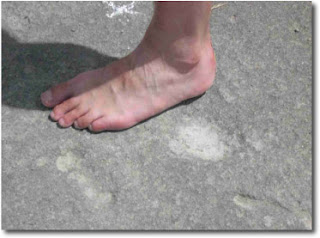
And let me refresh your memories about a post I’d made while back (here). In a Mexico rock quarry, some modern human foot prints were discovered in the rock. When the rock was dated via a radioactive dating method called argon-argon, it was thought to have been around 1.3 million years old. It was a controversy to evolutionists because their theory states that modern man did not exist in Mexico 1.3 million years ago. Either the date is wrong or their theory is wrong. Well, they wouldn’t admit either was wrong. Instead, they looked at the footprints again and decided they were made by cows. (I still laugh every time I think about it!)

Now we see the opposite thing occurring. In the Arizona site, scientists mistook potholes for dinosaur footprints. The difference here is that they wanted to see dinosaur footprints. In the Mexico find, they didn’t want to see human footprints.

I’ve included both photos again here so they can be compared side by side. What do you think? In Arizona, scientists looked at potholes and saw dinosaur footprints. In Mexico, they looked at human footprints and saw cow footprints. It’s funny in a sad sort of way but these scientists are so blinded by their theory that they can’t see the evidence right in front of their eyes!

Look, I know that dino-footprints exist, but I also know that scientists have biases and they sometimes project their biases into their examination of the evidence. This first group wanted to see dino-footprints and so they saw dino-footprints. They see now they were wrong. The second group is convinced that dinosaurs lived millions of years ago. They’re wrong too; they just haven’t seen it yet.


Further reading:

Friday, November 7, 2008

Acts 2:4, Speaking in Tongues

The event at Pentecost has been much discussed and much argued. The coming of the Holy Spirit upon believers marked the beginning of the New Testament Church and was the fulfillment of Christ’s promise that He would not leave us alone but would send the παράκλητος, the “called beside” One Who would be our Advocate, Helper, and Comforter. (John 14:16-18). The most notable sign associated with the event is the disciples speaking in tongues.

καὶ ἐπλήσθησαν πάντες πνεύματος ἁγίου καὶ ἤρξαντο λαλεῖν ἑτέραις γλώσσαις καθὼς τὸ πνεῦμα ἐδίδου ἀποφθέγγεσθαι αὐτοῖς.

and they were all filled with the Holy Spirit, and began to speak with other tongues, according as the Spirit was giving them to declare. (Acts 2:4, Young’s Literal)

The word “tongues” is this verse is the Greek word γλῶσσα, which can mean the organ in the mouth or a language. γλῶσσα is modified by the adjective ἕτερος which is commonly understood to mean, “another of a different kind.” It was not simply “another” language – as in ἄλλος.

The verb ἐδίδου is in the imperfect tense. The imperfect, of course, suggests a continuous act. It further suggests that they spoke only as long it was being given to them. Thus, they kept on speaking while the Holy Spirit was continuously giving to them.

But what did the language sound like?

καὶ πῶς ἡμεῖς ἀκούομεν ἕκαστος τῇ ἰδίᾳ διαλέκτῳ ἡμῶν ἐν ἐγεννήθημεν;

and how do we hear, each in our proper dialect, in which we were born? (Acts 2:8)

Some translations, such as the KJV, have the word “tongues” here again. We can see though that it is the word, διάλεκτος from which we derive the English word, “dialect.” The men hearing the disciples were “from every nation of those which were under heaven” (ἀπὸ παντὸς ἔθνους τῶν ὑπὸ τὸν οὐρανόν), yet they heard the disciples not only in their own language (γλῶσσα) but even their own dialect (διάλεκτος). To the men who heard them, the disciples (who were all Galileans) were heard in the language of the hearer. And they not only knew the language, the disciples sounded like natives of all these other countries!

Obviously this was a miraculous language. But I suggest that the tongues spoken at Pentecost were heard as an ordinary language and did not sound like the "babbling" we sometimes hear modern speakers of tongues speaking today.

Wednesday, November 5, 2008

Matthew 5:13, The Salt of the Earth

"Ye are the salt of the earth: but if the salt have lost his savour, wherewith shall it be salted? it is thenceforth good for nothing, but to be cast out, and to be trodden under foot of men." Matthew 5:13

The Bible doesn’t command us to be the salt of the earth. It says we already are salt. But what exactly does it mean to be salt? There are at least three attributes of salt that I believe applies to Christians.

First, salt adds flavor. A touch of salt to a bland meal seems to perform a miracle and makes the blah meal suddenly delicious. Jesus said that He came so that we might have life and have it more abundantly (John 10:10). We don’t just get by in life, we have abundant life. Like salt flavors meals, I believe a walk with Christ adds flavor to life.

Next, salt is a preservative. People used to cover meat with salt to preserve it. For centuries it was the best preservative of food. How does it do this? It acts as an antibiotic in that it inhibits the growth of bacteria. Even a few bacteria in meat will multiply and spoil it. Compare that to leaven. Jesus warned His disciples to beware of the leaven of the Pharisees, Sadducees, and of Herod (Matthew 16:6, Mark 8:15, et al). In the Bible, leaven is a type of sin and the Bible warns that a little leaven will leaven the whole lump (1 Corinthians 5:6). Our society needs salt. Even a little sin will corrupt the whole nation.

Finally, salt makes people thirsty. Jesus said that He has living water which becomes in us eternal life. Whoever drinks the water He gives will never thirst again (John 4:13-14). It’s the job of Christians to make people want to drink that water. It’s our job to make people thirsty.

I’m sure there is much more truth that could be mined from Matthew 5:13, but these simple points should be self evident. As Christians, we should add flavor to life, we should be a preservative that staves off sin, and we should make people thirsty for the living water Christ promised them. We should examine ourselves. It’s a sobering thought. Are we salt? Do we have these three characteristics of salt or are we the worthless salt that has lost its flavor?

No on Gay Marriage

While a record number of voters turned out to elect the most liberal candidate to ever run for President, one issue was still too liberal for most people to accept. Amendments to ban gay marriage were on the ballot in 3 different states: CA, FL, and AZ. In all 3 states, the amendments passed (source).

In 2002, prop 22 was passed in CA, which should have banned gay marriages then. However, in typical liberal fashion, the vote was challenged in the courts and the law was overturned via judicial activism (note to voters – Obama will be appointing judges for the next 4 years!).

Radical groups are intent on foisting the gay agenda upon the rest of us. You’ve seen the video of the first grade field trip to a lesbian wedding. As long as the courts continue to impose their will instead of the people's, we cannot count on the ballot box or legislature; constitutional amendments have to be the answer.

And another thing, marriage has been recognized as being the union of a man and a woman since the beginning of civilization. When exactly did it become an inalienable right? In the weeks leading up the vote on prop 8, opponents said very little about gay marriage; they made it into a “civil rights issue” and portrayed supporters of prop 8 as “bigots.” So humanity has just been “hate-filled” for all these years?

When asked about marriage Jesus answered, “Have ye not read, that he which made them at the beginning made them male and female, And said, For this cause shall a man leave father and mother, and shall cleave to his wife: and they twain shall be one flesh?” Matthew 19:4-5. God created marriage. It is what it is. Do we really have to explain ourselves?