googlef87758e9b6df9bec.html A Sure Word

Tuesday, August 28, 2012

Hybrids: Different Species, Same Kind

During my recent discussions about dogs and foxes, the subject of hybrids came up. Some subjects are a little more weighty than others and the weightier ones are difficult to discuss in a few paragraphs. Hybridization happens to be one of those weightier ones since there are so many examples of hybridization that I can't explore them all. Nevertheless, I'm always eager to give a layman's opinion in my effort to defend the faith so I'm going to plow ahead.

Hybrid” describes the offspring of two different species. Some people use reproductive tests to identify species. Thus polar bears (Ursus maritimus) are a different species than grizzly bears (Ursus arctos horribilis) because they don't normally reproduce together in the wild. However, we have discovered that, on rare occasions, these species have bred in the wild producing hybrid cubs. The offspring of such unions are called a “pizzly” if the father were a polar bear and a “grolar bear” if the father were a grizzly. Either way, the simple fact that these different species do occasionally hybridize in the wild undermines the use of a reproductive test to identify a species.

I've always favored using morphology to identify a species. Once a population has enough traits in common that they can all be identified as belonging to the same group, then they earn the moniker of species. Thus bears with large bodies, white fur, long necks, and pointed faces are “polar bears”; bears with smaller bodies, brown fur, short necks, and flat faces are “grizzly bears.” Admittedly that definition has it's own difficulties but at least it acknowledges the fact that identifying a species is more subjective than objective. It also dispels the mistaken impression that species are absolutely distinct and don't reproduce together.

The term “hybrid” is a sort of misnomer and gives a false impression of the importance of reproduction between different species. Hybridization is so common that I'm surprised that a reproductive test is even considered as a possible way to distinguish one species from another. The reproductive boundaries are crossed frequently in the wild and are absurdly common in captivity. Let's look at a few of the more interesting ones.

We've already talked about pizzly/grolar bear hybrids but there have been many crossovers between other bear “species” (usually in zoos): a Malayan Sun bear and a sloth bear, a sloth bear and an Asiatic black bear, a black bear and a spectacled bear, and a black bear and a sun bear.

Cat hybrids are fairly well known but the number of combinations is still remarkable. Lions + tigers is especially common; the offspring are called either ligers (lion fathers) or tigons (tiger fathers). Other examples among the Panthera genus include lion/leopard hybrids, lion/jaguars, tiger/jaguars, tiger/leopards, and jaguar/leopard. The features exhibited among the cubs of these unions sometimes blend the parents' features so well they appear to be Photoshopped together.

Horse and donkeys have been bred for centuries to produce mules. However, in spite of their differing chromosomes, horses call also reproduce with zebras (zorse) and zebras can breed with donkeys (zeedonks). The offspring of these combinations are almost always sterile.


Domestic cows can breed with buffalo (beefalo). 

Camels can breed with llamas (camas). 

Wolves can breed with domestic dogs (wolf dogs) and with coyotes (coywolves).
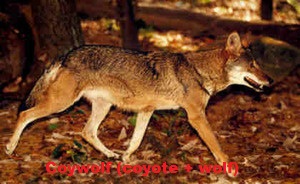
Besides mammal species, fish also hybridize. A while back, I blogged about hybrids between the Australian black-tip shark and the common black tip shark. Scientists called that “evolution in action” but I won't go into that now. It again represents the fact that the boundaries between species is not a reproductive one. Hybridization also occurs among birds, insects, and especially plants. Again, there are far more examples than I can begin to address in a single blog post.

Speciation and hybrization are especially relevant to an understanding of creation. The Bible says that God created animals “according to their kind” (Genesis 1). When Noah entered the Ark, he had “kinds” of animals on board with him. There are millions of known species and perhaps millions more undiscovered. However, the vast majority of these millions include bacteria, plants, algae, fungi, and insects. Noah did not have to make accommodations for any of these (though many probably did make their way on the Ark).

According to Wikipedia, there are only about 62,305 species of vertebrate animals. About ½ of these are fish and another 10% are amphibians. Noah did not have to provide for these either. That leaves less than 25K vertebrate species Noah had to concern himself with (never mind that some of the mammals and reptiles are also marine dwelling). So, does this mean that Noah had to take 50K animals on the Ark (a male and female of each species)? Hardly. We've already seen that “species” aren't distinct. There are eight species of bears but Noah did not have 16 bears on the Ark; he had 2. There are 41 cat species but Noah did not have 82 cats on the Ark; he had 2. Ditto for the many species of dogs, cattle, squirrels, deer, parrots, ducks, etc.

I've heard varying estimates of the number of animals Noah would have had to have on the Ark in order account for the number of species we have today. Some estimates are as low as 3,000 while others range as high as 15,000. Even the highest estimates are far less than the “millions of animals” caricature used by evolutionists to criticize the Flood event.

Species” is a label we use for convenience. Though I sometimes chide evolutionists about it, I really don't have a problem with the term; I only object to the idea that when populations specieate that they have somehow “evolved.” The ancestral kinds on the Ark were necessarily genetically diverse. The descendants of the original Ark-kinds (cats for example) have adapted to their various ecological niches around the world. The resulting populations are called “species” (lions, tigers, lynxes, ocelots, cheetahs, etc). Each one possesses different combinations of features already present in the original kind. When the different species hybridize, they merely recombine the same features in new ways. We could potentially get new species but we won't get new kinds.

Tuesday, August 21, 2012

To Speciate or Not to Speciate; What's the Question?

Secular science is the epitome of contradiction. I see it so often that it seldom surprises me anymore. While looking for quotes for my last post, I came across still another amusing example. Since it wasn't relevant to the point of that post, I didn't bring it up then. However, I cannot let it pass without comment.

In my last post, I quoted a NY Times editorial. You can read the entire article here but I wanted highlight two points it made.

The key event for the young Earth creationist interpretations of geology and biology is the great flood, which the [Creation] museum places at 2348 B.C. Obviously, Noah’s ark could not fit two of every single land animal. The exhibit notes that the Bible says two of every “kind” of animal, so there weren’t two dogs, two wolves, two dingo dogs, etc., but rather one pair of wolf-like dogs. After the flood, the two wolf-like dogs multiplied and “diversified” into a panoply of species.

That's a fairly accurate description of the typical, creationist position. The animals taken on the Ark were representative kinds and the thousands of terrestrial species alive today are descended from the few thousand kinds on the Ark. However, in the same article, the author made this comment:

Usually, creationists make a distinction between “microevolution” — antibiotic resistance among microbes, for instance, which they accept — and “macroevolution” — the appearance of new species, which they dispute.

Isn't that funny? I mean, which is it? Do creationists believe in speciation or don't they? Obviously creationists don't “dispute” the appearance of new species – I just object to calling speciation, “evolution” (either micro- or macro-). However, this science blogger can't seem to make up his mind. How can he say at one point that creationists believe in hyper-evolution only to immediately assert that creationists deny speciation at all? Such is the irrational reasoning of non-believers.

Evolutionists will sometimes say anything to discredit creationists. They will even lie. It's rather typical for them to make up caricatures of creationists beliefs which they then ridicule. Their default position is that creationists deny “macroevolution,” which they say includes speciation. This very claim was raised in the video, “Things Every Creationist Must Deny” which I blogged about a while back. However, when creationists talk about speciation that has occurred since the Flood, evolutionists do a 180 and accuse creationists of believing in “hyper-evolution.”

I've heard both of these criticisms before, I just can't think of a time when I've heard them both used at the same time. This particular evolutionist couldn't keep his objections straight so he employed them both.  It's a sort of reflex.  I often suspect evolutionists of not being sincere but in this case, I'm sure of it.

Monday, August 20, 2012

Is Creationism a Belief in Hyper Evolution?

Creationists believe that Noah took animals on board the Ark in pairs that represented kinds. Actually, it's not a creationist “belief” but rather what the Bible states overtly. Consider this passage (Genesis 6:19-20)
  
And of every living thing of all flesh, you shall bring two of every kind into the ark, to keep them alive with you; they shall be male and female. Of the birds after their kind, and of the animals after their kind, of every creeping thing of the ground after its kind, two of every kind will come to you to keep them alive.”
  
So the Bible is clear that animal “kinds” were represented on the Ark. A “kind” is broader than a species. In taxonomical terms, a kind is probably closer to a family than a species. Noah did not have 2 lions, tigers, cougars, lynxes, leopards, ocelots, cheetahs, and house cats on the Ark; instead, he only had one pair of a “cat-kind.” From these two ancestral cats, all other species of cats have descended. One straw man criticism of the Ark is that there is no way that Noah could fit 2 of every species of animals on the Ark. Since Noah only brought animals on the Ark according to their kind, the number of animals necessarily on the Ark is much less than the critics' inflated estimates.
    
There's a tired, old retort employed by evolutionists whenever creationists talk about speciation after the Flood. They assert that the few centuries or even millennia since the Flood is not enough time for the many thousands of species of animals to have descended from the few thousand kinds of animals that were on the Ark. They say that such rapid diversification is a type of "hyper-evolution."
 
In a NY Times editorial called, “Creationism = Evolution?” (note the use of the word “creationism” by the way; see my last post on that subject), one science blogger made the following comments after visiting the Creation Museum:

The descendants of the ark dog include foxes, states one of the museum signs. This is pretty incredible if you don’t accept the theory of evolution. Dogs (and wolves) have a genome of 78 chromosomes. The red fox has 34 chromosomes. By most any measure, dogs and foxes are different species and yet here in the Creation Museum, it was stated that foxes had diversified from dogs, with major changes in appearance and genetic make-up, in an incredibly short time of less than 4,500 years — far, far faster than an evolutionary biologist would claim.
  
If animals speciate rapidly, evolutionists call it “hyper-evolution.”  Part of the confusion in the above quote stems from their penchant to call any kind of change, “evolution.” I've written about that before.  It's a misnomer but not one which I'll visit again in this post.
  
A common understanding about evolution is that it is a “gradual” process. This stems from several different lines of reason which include things like the rate at which mutations occur in DNA, the length of the reproductive cycles of the host, and common interpretations of geological ages. In some instances, our observations of living populations seems to concur with the idea of gradual evolution since most of the minor variations we observe (what some people call “microevolution”) would have to continue for a very, very long time before they amounted to any significant changes in the populations.

What seems to escape many evolutionists is a very simple point which, to me, seems ridiculously obvious. Animals are adapted to their environment. Unless the environment should suddenly change, there's no reason to expect rapid change in the animals that occupy that environment. So animal populations continue in long periods of stasis, showing only minor changes in response to the minor changes in the environment – like the beaks of Darwin's finches. If these minor changes were all that occurred, then evolution would indeed be a staggeringly slow process.
 
The world after the Flood, however, was marked by dramatic environmental change. The specialized niches once occupied by the animals on the Ark no longer existed. The animals had to make their way in a new, very different world where the rule was to adapt or die. Rapid speciation necessarily was the norm – not over thousands of years or even over centuries. I'm talking about rapid speciation occurring in a few decades!
 
In spite of their claims to the contrary, rapid speciation should not be a surprise to evolutionists because there are many examples of rapid changes in species in response to sudden changes in their environment. Very early on in my blogging career, I posted this quote from Sciencedaily:

"Countering the widespread view of evolution as a process played out over the course of eons, evolutionary biologists have shown that natural selection can turn on a dime -- within months -- as a population's needs change. In a study of island lizards exposed to a new predator, the scientists found that natural selection dramatically changed direction over a very short time, within a single generation, favoring first longer and then shorter hind legs."

Ignore the conflation of “evolution” and “natural selection” for a moment. In light of this comment, it's rather hypocritical for evolutionists to say thousands of years since the Flood is not a long enough time for diverse changes to occur in the descendants of the kinds that were on the Ark. The environmental change in this experiment was rather subtle – they introduced a new predator onto a group of islands. Yet the indigenous species of lizard began to adapt quickly - "within months" according to the article. How much more dramatic was the change in environment after the Flood? The animals then would begin to adapt just as quickly.

Now the quote from the NY Times editorial above specifically said that 4,500 years is not enough time for foxes to split from other dog species. That belief is contrary to the experiments done by Russian scientist, Dmitry Belyaev. In the 1950s, Belyaev used wild, silver foxes in a study about the domestication of dogs. He would put his gloved hand into the cage with a wild fox to try to pet or feed the fox. Foxes that were the most curious or docile were selected to reproduce. Through this form of artificial selection, rapid and dramatic changes took place among the silver foxes:
  
Belyaev and his colleagues did indeed create a population of foxes that differed in temperament and behavior from their wild cousins. The foxes changed physically as well, with alterations in coat color appearing as early as the eighth generation—typically a loss of pigment resulting in white patches. The foxes also developed floppy ears and curved tails, mirroring traits seen in dogs as well as other domesticated species.” (bold added; source here)

In less than a decade, these wild foxes began to look like domestic dogs. Their behavior changed as well to include things like whining and barking, traits also seen in domestic dogs. Certainly there has been some mutation to the DNA of these creatures since they have a different number of chromosomes but if these foxes could be turned into dogs in a few generations, saying 45 centuries isn't long enough for them to have split from dogs is laughable.

I've said before that, for evolution to occur, novel traits have to be added to a population. The removal of traits from a population will not allow the population to “evolve” regardless of how long the change occurs. On the other hand, if adaptation occurs primarily via different combinations of traits already present in a population, then speciation can occur in a few generations. Long ages aren't even necessary.
  
Time is not the hero of evolution. It's not even a player in the game. Gradual change is a flawed idea that is practically built into the long age assumptions of evolutionary theory. It's contradicted by simple observation.

Tuesday, August 14, 2012

Evidence for “Creationism”


I've written many times before on how evolutionists and other skeptics abuse the language. They don't do this out of ignorance but rather they intentionally misuse words in order to obfuscate. It's rather dastardly because they're the ones who usually insist that other people use words according to how the evolutionists themselves have defined them.

One of their most flagrant abuses concerns the word, “creationism.” Now, “creationism” is a fine word and I have no objection to it when it is used correctly. Unfortunately, many evolutionists refuse to use the word correctly. There's an old saying that there are no stupid questions. However, whenever I hear some evolutionist ask, “What is the evidence for creationism?,” I'm tempted to call it a stupid question.

Words that end in “ism” describe a philosophy, worldview, or belief system: atheism, Buddhism, capitalism, etc. “Creationism,” then, describes the belief that God created the world. Get it? It's a worldview. It's not the same thing as “creation” even though many evolutionists seem to think the words are interchangeable. I can't tell you the number of times I've heard critics make stupid remarks like, “what is the evidence for creationism?” Don't they realize that, when they phrase the question like this, they are asking for evidence that there are people who believe in creation? Is that what they want? I know it's not. They mean to ask, “what is the evidence for creation?”

Why do evolutionists consistently use “creationism” when they mean “creation”? There's a very simple explanation. They want to emphasize the “belief” aspect of creation. They don't want to dignify the idea of God creating the universe by using a term like, “the theory of creation” so they will only refer to the act of creation as “creationism.”

Their stubborn attempts to conflate creation with creationism has given me more than a few chuckles. For example, try doing a Google search for the term, “there is no evidence for creationism” and see the tens of thousands of evolutionists who have made the silly statement. How ironic it is that in the midst of their heated disagreement with creationists, evolutionists will actually say there is no evidence that people believe in creation! Isn't that a hoot?!

Now, people who subscribe to “creationism” are called “creationists” - just like people who subscribe to atheism are called atheists. “Creationist” is a perfectly accurate and acceptable description, one which I welcome and use myself. However, besides their misuse of the word “creationism,” evolutionists also refuse to acknowledge the simple reverse; a belief that life arose via evolution is “evolutionism” and people who subscribe to evolution are “evolutionists.” Many evolutionists, though, militantly reject the label. Their determined effort to disassociate themselves from the term is still another source of amusement for me. Through gritted teeth they claim there are no such things as “evolutionists.” Oh, if only that were true!