googlef87758e9b6df9bec.html A Sure Word: Leviticus
Showing posts with label Leviticus. Show all posts

Wednesday, December 2, 2015

Is the Bible Immoral? Part 3: Does the Bible Condone Slavery?

Your male and female slaves are to come from the nations around you; from them you may buy slaves. You may also buy some of the temporary residents living among you and members of their clans born in your country, and they will become your property. You can bequeath them to your children as inherited property and can make them slaves for life, but you must not rule over your fellow Israelites ruthlessly. (Leviticus 25:44-46, NIV)

Another way that critics try to portray the Bible as “evil” is to claim that the Bible condones slavery. The criticism strikes a chord with many people because of America's tragic history of slavery. We consider ourselves to be a better nation for having ended the practice here and so, when we read passages like Leviticus 25 which seem to support slavery, doubt about the Bible can creep into our minds.

It should be noted first that there's a little bit of dishonesty behind the criticism – even if it's not intentional. When we hear the word, slavery, we immediately think about the subjugation of blacks in the South. It's a highly, emotionally charged word which is the impression critics want us to have. It's an unfortunate consequence of translation that words of different languages seldom have exactly the same semantic range of meaning. It's nearly unavoidable that when we substitute an English word for a Hebrew or Greek word, we interpret the text according to our understanding of the English word. In English, slavery sounds like a terrible thing which makes this criticism seem to have merit.

This is not a trivial point. This criticism's entire weight rests upon the negative connotation implied by the word, slavery. Critics routinely beat this drum by using disparaging language like, “Except for murder, slavery has got to be one of the most immoral things a person can do” (source). It's a type of straw man argument. The moral quandary only exists if the slavery mentioned in the Bible resembles the slavery as the typical, modern reader understands it.

The reality is that the “slavery” discussed in the Bible is not at all like we experienced in the US. For example, Exodus 21:16 specifically proscribes the death penalty for anyone who kidnaps a person in order to sell him. In his letter to Timothy, the Apostle Paul includes “enslavers” (ESV) in the same list as murderers, liars, and other sinners (1 Timothy 1:8-10). The type of slavery once practiced in the US, where dark-skinned natives were kidnapped in Africa and sold in America, is specifically forbidden in Mosaic Law and is clearly identified as a sin.

When the Bible talks about “slaves,” it is primarily talking about 2 groups of people. First, a tiny minority of slaves were prisoners taken in war. War was a grim reality at the time of the Old Testament and conquered kingdoms meant defeated populations that needed to be dealt with. If you defeat and enemy, you can't simply pack up and go home or else you'll be fighting the same enemy again sometime later. The Law gave instructions in dealing with enemy prisoners that was more practical than internment camps and more humane than summary execution. This doesn't mean that God “condones” war or slavery. Just like Jesus said about the law allowing divorce (Matthew 19:8), laws dealing with captured prisoners were merely allowances made for people living in a fallen world. It doesn't reflect God's perfect will.

The far more common slaves in biblical times are what we might call indentured servants. In biblical times (both the Old and New Testaments), there were no such things as government welfare or bankruptcy. Out of economic necessity, chronically poor people could pledge their future labor in exchange for things like forgiveness of debt, a lump sum of money, and food and shelter. The practice isn't as foreign when we look at similar arrangements that aren't called slavery. Kings had vassals. Knights had squires. Vassals never became kings and squires never became knights but in both situations, the subordinate served the master exclusively and permanently.

Such an arrangement might still sound bizarre to modern readers, but it was often easier for the impoverished person to do this rather than try to provide for himself. Once again, such an arrangement isn't “condoned” by the Bible. God created a world where “work” meant tending a garden and picking food off the trees to eat. In the fallen world, people have to work hard to eat. This type of arrangement existed and the Law gave instructions to regulate it.

It would take too much space to address every verse in the Bible that discusses slavery but, in general, the Bible tries to make the arrangement more professional and less like “slavery” as we typically understand it. Colossians 4:1 commands masters to treat their slaves “justly and fairly.” Jewish slaves were commanded to be freed in the year of Jubilee (every seven years). Even after being freed, a Jewish servant could choose to permanently remain with his master. In other nations, female slaves were often used for sex but the Law commanded that if a Jewish owner had sex with a slave, he must treat her like a wife. These are just a few of the types of regulations the Bible lists concern the practice.


Finally, God ultimately does not distinguish between slave and master – both are equal in His eyes (Galatians 3:28). In his letter, Paul tells Philemon to receive Onesimus, not as a slave but as a brother (Philemon 1:16). Paul even refers to himself as a “slave” to Christ (Greek, δοῦλος, Romans 1:1, et al). Indeed, Christ Himself gave us the parable of the unprofitable servant, Luke 17:7-10. He has forgiven my debt, paid the penalty for my sins, and given me eternal life. He is my Lord. I owe Him all I have and could serve Him my entire life and still never repay all He has done for me.

Saturday, November 14, 2015

Is the Bible Immoral? Part 1

Some people criticize the Bible with the claim that it is immoral. That is, they believe the history recorded in the Bible and the commandments of the Mosaic Law offend our sense of right and wrong and so are evidence that the Bible is not the revelation of a good God. It's an excuse to not be a Christian or believe in God.

Critics who use this argument will also sometimes accuse Christians of picking and choosing which parts of the Bible we want to believe. If a Christian, for example, speaks out on the political issue of gay marriage, a critic might ask why doesn't the Christian also believe in executing homosexuals as commanded in Leviticus 20:13? This is an obvious attempt to undermine the Christian's credibility, claiming he appeals to the Bible when condemning homosexuality but ignores other parts of the Bible. If Christians feel we can ignore parts of the Bible with which we disagree, then how can we condemn the critic for doing the same?

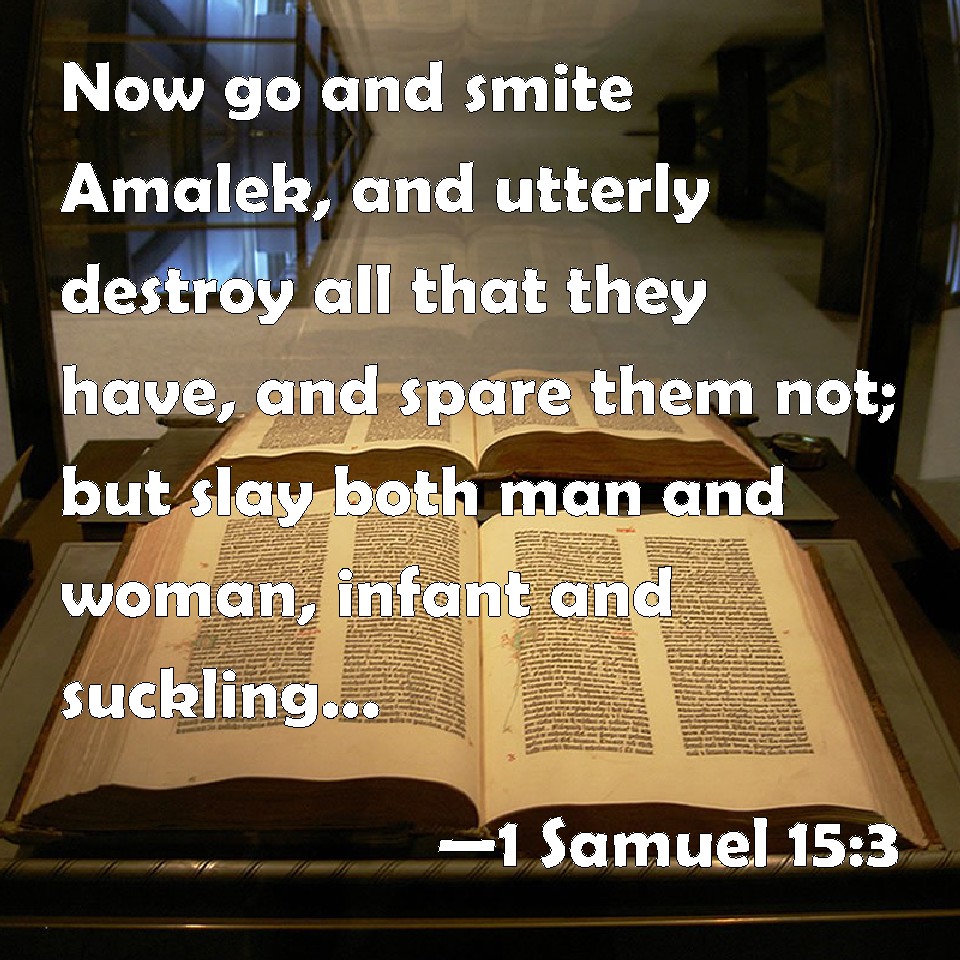
Two of the most often cited examples of the Bible's immorality are probably God's command to the Israel army to kill the Amalekites (1 Samuel 15) and the Bible seeming to condone slavery (Leviticus 25:44-46, et al). I intend to discuss these two examples in more detail in my next two posts. In this post, I intend to discuss the weakness of these criticisms in general.

When responding to arguments like this, there are several points that should be kept in mind. The first, and probably the most significant, is to ask by what standard does the critic judge these acts to be “wrong”? If there were no God, then the universe is empty of morality. Everything that happens is nothing more than matter acting on matter. One man killing another is no more “evil” than a lion killing a zebra. When a person says it's “wrong” for God to command the Israelites to kill the Amalekites, it begs the question: wrong according to who? Obviously the Universe doesn't care what happens. The Israelites didn't believe it was wrong. What makes the critic's opinion on the subject the “correct” one? No one can call anything “wrong” without first acknowledging an absolute standard of right or wrong exists. There is no such standard in an impersonal universe. Objective morality exists only if God exists.

Moving on to my second point: We can see that the critic can't ever objectively say the Bible is wrong. At best, he can only say his sense of morality differs from how he understands the Bible. Ok, then what is the critic's point in raising this criticism? Is he trying to say there is no God because the Bible records things he finds offensive? You can see how that doesn't work. It would be sort of like me saying the Holocaust didn't happen because no dictator could be that cruel. This is a logic fallacy known as an argument from outrage.

Noted apologist for atheism, Richard Dawkins, wrote in his book, The Greatest Show on Earth, “Even if it were true that evolution, or the teaching of evolution, encouraged immorality that would not imply that the theory of evolution was false.” This is one of the few things on which Dawkins and I can agree. I would never try to attack evolution by saying Darwin was a racist. By that same token, though, someone claiming the Bible is immoral is not evidence that the Bible is not true.

We can see already that these criticisms of the Bible are built upon shaky foundations. Yet there are still a couple of more points we must consider. One thing is that God established the Law specifically for His people. When God established the Nation of Israel, it differed from other nations in that it did not have an earthly ruler – God was their ruler. The Jews lived their lives according to the Law and Judges were appointed to interpret the Law whenever a dispute arose.

Eventually, the people demanded to have a king like other nations. God relented and gave them Saul. Since then, we are subject to earthly rulers and laws during our lifetimes. The Law commanded that adulterers, for example, should be stoned. In the US, adulterers aren't executed but God is still the final Judge and someday we still must stand before Him to give an account for our sins. We are still judged according to the Law. However, the punishment for our sins is no longer necessarily at the hands of earthly rulers.

Finally, the Law was given to a fallen world. Some of the things it contains do not represent God's perfect will but rather are allowances God has made for sinful people who live in a corrupt world. Consider this passage from Mark 10:

And the Pharisees came to him, and asked him, Is it lawful for a man to put away his wife? tempting him. And he answered and said unto them, What did Moses command you? And they said, Moses suffered to write a bill of divorcement, and to put her away. And Jesus answered and said unto them, For the hardness of your heart he wrote you this precept. But from the beginning of the creation God made them male and female. For this cause shall a man leave his father and mother, and cleave to his wife; And they twain shall be one flesh: so then they are no more twain, but one flesh. What therefore God hath joined together, let not man put asunder. (Mark 10:2-9)

We see in this passage that when Jesus was asked about divorce, He explained that it was God's intentions that people never divorced. The Laws governing divorce were only written because of the hardness of our hearts. So even if the Bible seems to allow certain things, it does not necessarily mean the Bible “endorses” that thing.


I'll talk more about specific examples in my next couple of posts. For now, suffice it to say these are weak criticisms of the Bible.

Sunday, February 27, 2011

2 Corinthians 9:7: Cheerful or Hilarious?

In another post (here), I mentioned the exegetical fallacy of “reverse etymology.” This is where people force the modern meaning of a word onto its original meaning. In that other post, I talked about how some critics attack the Bible because the Hebrew word עוֹף (oph) seems to contradict their understanding of the modern word “bird” (Leviticus 11:13,19). However, the fallacy of reverse etymology isn't practiced only by critics. It is more often used by well meaning Christians – even pastors. One example of this fallacy I've heard from well meaning Christians concerns 2 Corinthians 9:7:

Each one must do just as he has purposed in his heart, not grudgingly or under compulsion, for God loves a cheerful giver.

The word translated here as “cheerful” is the Greek word ἱλαρός (hilaros) – used here in the neuter, ἱλαρὸν. You might recognize the word. It is from ἱλαρός that we derive our English word “hilarious” and it is on that fact that I've heard many well intended pastors pounce. They say, for example, that tithing shouldn't just be joyous, it should be “hilarious.” The problem with this view is that English word hilarious, though it may be derived from the Greek, still carries a different meaning to the modern hearer than it did for the original audience.

Strong (word # 2430) defines the word simply as “joyous, cheerful, not grudging.” HELPS Word Studies expounds on this a little: “properly, propitious; disposed because satisfied – describing someone who is cheerfully ready to act because already approving ("already persuaded"). hilarós ("won over, already inclined") is only used in 2 Cor 9:7 where it describes spontaneously non-reluctant giving.”

Tithing is a form of worship. Everything we have is given to us by God (John 1:16). When we tithe, we give back a portion of what God has given to us. We should want to do this. It should be done with a glad heart and not begrudgingly. This is what 2 Corinthians 9:7 is telling us and this is what is meant by the word ἱλαρὸν. That is how the original hearers would have understood it.

Something different is meant by the word hilarious. Hilarious describes something that is extremely funny. Those pastors I've heard use this point try to suggest we should be happy to the point of laughter. It's as though we should be rolling on the floor laughing when the offering plate goes around. Do you really think that is what Paul meant? Tithing is joyous but it's not a joke.

I believe there is great value in studying the original meaning of words. Word Studies are fantastic tools that can give us new insights into familiar passages. However, we need to be careful as we consider these words. Remember that when the Bible was being written, English didn't exist. It's a powerful temptation to project our understanding of a word onto its original meaning. We need to resist that temptation. Do not consider what the word means now; instead, ask yourself what the word meant then.

Saturday, October 16, 2010

Answering the 10 Questions Every Christian Must Answer: Part 4

#3) Why does God demand the death of so many innocent people in the Bible?

#5) Why is God such a huge proponent of slavery in the Bible?

Here again we have two questions that seem to make duplicate points. Therefore, as in my last post, I will respond to both in a single post. In a nutshell, the video is attempting to make the point that many Old Testament laws do not reflect how we think a just and loving God should act. The video cites Exodus 35:2, Deuteronomy 21:18-21, Leviticus 20:13, and Deuteronomy 22:13-21 as examples of God condemning people to death for “trivial” crimes. Concerning slavery, the video cites Exodus 21:20-21, Colossians 3:22-24, Ephesians 6:5, and 1 Peter 2:18 (interestingly, the latter 3 are from the New Testament).

I'd like to clarify one very fundamental point that the video seems to not be aware of: there is exactly one penalty for sin – death (Romans 6:23). No matter what the crime, ultimately, the punishment is the same. The video seems to want to make hay that the OT condemns to death people who work on the sabbath. However, people who lie are also condemned to death as are people who lust, covet, gossip, and hate. The Bible makes it clear that all men are appointed to die and then they are judged (Hebrews 9:27). Some people die very old and some die very young. Some die peacefully and some die violently. When and how they die might vary but just as all have sinned, so all die (Romans 5:12). The mortality rate among humans is 100%. When you think about it, it's sort of silly to say that there's anyone who doesn't deserve to die. If everyone dies, then how can we say that a rebellious son or an adulterer isn't worthy of death?

I really shouldn't need to give much ink to proving that everyone dies. It's rather obvious. With that understood, one might ask why some OT laws called for immediate death in certain circumstances. A thorough treatment of this is beyond the scope of this post but let me give a thumbnail version. The various laws can be divided into a few categories: there are laws concerning worship, morality, civility, and health. The law governs our relationship with God and our relationship with others. In many cases, our relationship with God is reflected in our relationship with others. Marriage, for example, is a picture of Christ's relationship with His church (believers are collectively known as the “bride” of Christ). Sexual sins, therefore, are especially egregious on the same level as idolatry. Our relationship with our parents is a model of our relationship with God. A rebellious child, then, is akin to apostasy.

Furthermore, the Law was given specifically to govern God's people. They were a unique nation in history in that they had no earthly ruler. God was their King and He appointed judges who would interpret the Law whenever a situation arose. Sexual immorality, rebellion, idolatry, and other sins which the video might label as “trivial” were a poison to society. In that place at that time, God did not allow certain sins to continue for His people. We live in a different time now. God's people foolishly demanded a king who could rule over them like other nations and God gave them Saul. Ultimately, God still holds us accountable for our sins but He allows our earthly punishment to be doled out by our earthly rulers.

Which brings us to another point. Many of the laws were not given to reflect God's perfect will but rather to tolerate our own sinful nature. Jesus made this very point to the Pharisees when they asked about divorce (Matthew 19:7-9), “They say unto him, Why did Moses then command to give a writing of divorcement, and to put her away? He saith unto them, Moses because of the hardness of your hearts suffered you to put away your wives: but from the beginning it was not so. And I say unto you, Whosoever shall put away his wife, except it be for fornication, and shall marry another, committeth adultery: and whoso marrieth her which is put away doth commit adultery.” Divorce, then, wasn't intended as God's perfect will but rather God made provisions that accommodated divorce in a fallen world. Such were the laws concerning slavery. This was not the kind of slavery that existed once in the US, by the way, but God gave laws that covered indentured servants or prisoners of war. This was not because God intended slavery but rather made provisions for it in a fallen world.

No sin is “trivial.” The video might dismiss blasphemy, sexual immorality, and rebellion as harmless but any transgression of the law earns God's judgment and the wages of our sin is death. Nobody is stoned anymore but we all have the same destiny - a grave. We all also have the same opportunity - salvation through His Son. When we stand before God in judgment (and we all will), I'm going to receive mercy because I have believed in His Son. Others are welcome to tell God He's being unfair.

Part 1

Part 2

Part 3

Part 5

Part 6

Part 7

Part 8

Tuesday, February 16, 2010

How to Answer “The Bible says that Bats are Birds” and Similar Criticisms

In an effort to attack Christian faith as a whole, many critics attempt to discredit the Bible. Many of their criticisms are similar and can be grouped into a few categories. Most of the criticisms in one category can be rebutted in pretty much the same way so it's important that Christians learn how to identify common criticisms so that we can give a proper response (1 Peter 3:15).

One such category is “reverse etymology” (as identified in “Exegetical Fallacies” by D. A. Carson). Reverse etymology occurs when we force our modern understanding of a term onto the original meaning of the term. Look at the following example:

“These, moreover, you shall detest among the birds; they are abhorrent, not to be eaten: the eagle and the vulture and the buzzard,... and the stork, the heron in its kinds, and the hoopoe, and the bat.” (Leviticus 11:13,19, NASB)

Now, everyone knows that bats are not birds and so this “proves” the Bible is wrong, right? Well, bats are not birds according to modern taxonomy. However, when Moses penned Leviticus, Linnean taxonomy was still a few dozen centuries away. As a matter of fact, the word “bird” likely did not even exist yet since it is an English word.

The word translated above as “bird” (“fowl” in the KJV) is the Hebrew word “oph” (עוף) which literally means “winged.” Regardless of how we define a bird today (feathered, egg-laying, etc), the Jews of antiquity were certainly not wrong to identify both birds and bats as winged!

In the same chapter of Leviticus we see a similar “problem” when the Bible says the hare chews its cud (Leviticus 11:6). Again, what is meant by the term “chew cud”? We have a specific, scientific understanding of the term but our modern understanding isn't what the ancient Jews would have understood. Cows have a divided stomach and regurgitate partially digested food to chew further. Rabbits do not have a divided stomachs but they do pass stools of partially digested food which they then eat and chew in much the same manner as a cow chews its cud. The difference between the two is a modern technicality. The Bible is certainly not “wrong” for not clearly distinguishing the hare from what are now identified as ruminants.

Still another example concerns the whale. Jonah 1:17 says that the Lord had prepared “a great fish” to swallow Jonah. However, later, in Matthew 12:40, Jesus said that Jonah was swallowed by a “whale” (KJV). Seeing these verses side by side, it looks as though the Bible is calling a whale a fish. Yet again, “fish” is a modern, English word that has a specific meaning (scales, gills, etc). The Greek word in Matthew is kētos (κῆτος), which is rendered in other translations as “sea monster.” A marine animal large enough to swallow a man can be correctly identified as a “sea monster.” The exact species of animal it was is unknown.

One final example from this category concerns insects. If we again look in Leviticus 11, vv. 20-23 seem to indicate that insects have only 4 legs. Here, the critic believes is an inescapable error; after all, surely the Bible can't have a different understanding of the word “leg,” can it? In a sense, that is exactly the case! The solution is found in Leviticus 11:21 – the four legs used for walking are distinguished from the two legs used for jumping.

We can see that arguments like these are very shallow and fail to stand up to even the slightest scrutiny. Still, these arguments and other like them persist and so we must be ready. Don't get caught off guard by such a simple canard.

Friday, August 21, 2009

John 20:17: Touch Me Not

λέγει αὐτῇ Ἰησοῦς· μή μου ἅπτου, οὔπω γὰρ ἀναβέβηκα πρὸς τὸν πατέρα·

“Jesus saith unto her, Touch me not; for I am not yet ascended to my Father:” (John 20:17 KJV)

My blog today isn’t really so much of a revelation as it is an explanation since many translations have this verse correct. But because the King James Version (and a few others) renders this verse as “touch me not,” this passage has led to a lot of speculation about what Jesus meant.

According to Scofield, one possible interpretation of this is, “That Jesus speaks to Mary as the High Priest fulfilling the day of atonement (Leviticus 16). Having accomplished the sacrifice, He was on His way to present the sacred blood in heaven…” In other words, Jesus was going to the Father to present His own blood as the payment for our sins. He did not want Mary to touch Him lest some of His blood would cling to her. That’s an awful lot of speculation crammed into three words. It’s also counterintuitive when you consider the amount of blood that was surely spilled during the act of the Crucifixion (as in John 19:34).

Another explanation I’ve heard goes thusly: “… He appeared to Mary Magdalene the next morning, the day after the weekly Sabbath during Unleavened Bread, when the priests presented the wavesheaf offering. He did not permit her to touch Him because He had not yet ascended to the Father. Just as the High Priest had to wave the sheaf of grain before the spring harvest began, so our Savior had to ascend to the Father that day to be accepted before Him. Once this happened, He allowed His disciples to touch Him.”

These speculations, and many others, all hinge on the misunderstanding that Jesus did not allow Mary to touch Him. A reading of the verse in Greek, however, might dispel such speculation about Jesus’ true meaning. ἅπτου is in the imperative mood and is modified by the negative particle μή. When μή is used to modify a verb in the imperative mood it generally means to stop an action that is already in process. In this case, Mary was already touching Him! So Jesus did not forbid Mary to touch Him; rather, He was telling her STOP touching Him because He was to ascend to the Father.

We see this conclusively in Matthew 28:9:

"And as they went to tell his disciples, behold, Jesus met them, saying, All hail. And they came and held him by the feet, and worshipped him."

This passage makes clear that the women held Him by His feet.

Consider these other, popular translations:

“Jesus said, "Do not hold on to me, for I have not yet returned to the Father.” (NIV)
“Jesus said to her, "Stop clinging to Me, for I have not yet ascended to the Father;” (NASB)
“Jesus saith to her, `Be not touching me, for I have not yet ascended unto my Father;” (Young’s Literal)
.
Don’t waste too much time pondering why Jesus wouldn't let Mary touch Him. A casual reading in the Greek shows prohibition was not necessarily even implied.