googlef87758e9b6df9bec.html A Sure Word: Bible contradictions
Showing posts with label Bible contradictions. Show all posts

Friday, February 10, 2017

Can a person lose his salvation? Part 4

I don't believe a person can lose his salvation. In this series until now, I've cited verses in the Bible that clearly say that our spiritual birth is like our physical birth – it is a transforming event that permanently assigns who we fundamentally are. Furthermore, once we are saved, God promises to keep us. In light of these verses, I cannot see how salvation could be temporary or conditional.

Of course, other people will cite other verses that seem to suggest that it is possible to lose our salvation. When confronted with two passages that seem to present differing ideas, the solution is not to decide which passages we believe are correct. The reality is that both verses are correct and the truth lies in a harmony of the two. In this post, I will discuss some of those passages often cited to support the idea that a person could lose his salvation.

Some passages that people cite, seem to include a condition of continuity. Consider Revelation 3:5:

He who overcomes will thus be clothed in white garments; and I will not erase his name from the book of life, and I will confess his name before My Father and before His angels.

In my first post in this series, I quoted a website that used the analogy of a free car to represent salvation. That author was full of analogies. When discussing Revelation, he said this:

Notice that God's pencil, which wrote your name in the Lamb's book of life, also has an eraser at the other end. The name can be erased from the book of life if you don't overcome.

Can I just say that I find it odd that someone would quote a promise where Jesus says He will not do something and use it as evidence that He might do it? Anyway, the author is attempting to highlight the condition that a person must overcome or else his name will be erased from the Book of Life. There are other verses that seem to carry similar conditions:

But Christ as a son over his own house; whose house are we, if we hold fast the confidence and the rejoicing of the hope firm unto the end. (Heb 3:6)

For we are made partakers of Christ, if we hold the beginning of our confidence stedfast unto the end; (Heb 3:14)

By reading just these verses, the implication seems to be that we must continue professing our faith until the end in order to receive our reward. But as I've already said, our understanding of any verse must be tempered with the rest of the Bible. In a previous post, I cited 1 Corinthians 1:7-8:

Therefore you do not lack any spiritual gift as you eagerly wait for our Lord Jesus Christ to be revealed. He will also keep you firm to the end, so that you will be blameless on the day of our Lord Jesus Christ.

If my continuance in the faith rests in my own hands, then my salvation is in peril. My flesh is weak. My faith wavers. But Jesus has saved me and He lives to continuously makes intercession for me. Those verses that talk about salvation being conditional on my continued faith must be in harmony with the promise that I am kept by the power of God. I know I will stay fast to the end because He has promised to keep me firm until the end.

There are other verses I could cite but I don't want to make this post too long. In short, it's my opinion that nearly all of the verses usually cited could be characterized as “negative arguments.” This is where a verse says one thing and the argument is made about what would happen if the opposite were true. I can't say I never make negative arguments but I don't believe negative arguments are strong arguments. I might say, for example, “I work hard so I can get ahead.” The opposite would be, if I don't work hard I won't get ahead. Perhaps I wouldn't, but where in that argument is found the possibility that I won't continue to work hard? I believe the same thing is true of the Bible. Perhaps if I stopped believing I could lose my salvation but that doesn't necessarily mean it is possible for a truly saved person to stop believing.

Perhaps the most cited verse to support the possibility of a person losing his salvation is John 15:1-2:

I am the true vine, and My Father is the vinedresser. Every branch in Me that does not bear fruit, He takes away; and every branch that bears fruit, He prunes it so that it may bear more fruit.

This is almost cited like a “gotcha” verse. At first reading, this verse is also a type of condition where God “takes away” any branch not bearing fruit (“cuts off” in the NIV). In other words, if a branch doesn't bear fruit, it's cut off. I very, very seldom appeal to the original language but, in this case especially, I believe most, mainstream versions of the Bible don't accurately translate this verse.

The word being translated is the verb, airw (airō, Strong's 142). It is sometimes translated as “takes” but the primary meaning is “lift up.” Even in verses where it is translated as “takes,” the meaning is still usually, “take up” or “pick up.” In the parable of the sower (Mark 4:15), for example, Satan “takes” the word which had been sown; the picture painted in the parable is of a bird “picking up” the seed that fell by the way.

In John 15, Jesus creates the metaphor of the Father as a husbandman. Every branch that abides in Him will bear fruit. He “lifts up” the downtrodden branches so that they are able bear fruit and He prunes the fruitful branches so that they can produce even more fruit. This is easily understood by anyone who has seen a vineyard. Even today, branches are still tied and held up from the ground. Note that in verse 6, it is only those branches that do not abide in Him (i.e. are not Christians) that are cast into the fire.

I believe the problem is that we sometimes see instances of people who profess to be Christians and seem to be saved, but later they reject Christ and live like they're lost again. They fit the bill of people who seem to have been saved but did not continue in the faith. Earlier I used the term, “truly saved.” I chose that deliberately because I believe many of the verses that seem to talk about someone losing his salvation are actually talking about people who were never saved. That will be the subject of my next and final post in this series.

Read the entire series

Wednesday, January 11, 2017

Can a person lose his salvation? Part 1


There are some theological issues I won't debate with other Christians because I believe they are of little consequence. An example is the question of predestination (aka, election). God clearly commands us to share the gospel so I will share the gospel. What's the use of debating whether a person has the free will to respond or if God gives him the ability to respond?

There are some issues, of course, where I take a definite position and this includes the question, can a person lose his salvation? In my opinion, what a person thinks about losing his salvation reveals how he thinks a person is saved. If someone thinks a person could lose his salvation by sinning, for example, it may be because he thinks salvation is earned by good works. What's more, if it is possible to lose my salvation, I want to be sure I know if mine is at risk.

Concerning losing salvation, one website offers this analogy:

Suppose a friend gave me a brand new car which he paid out of his own money, and simply gave me the title and keys and said, "It's yours, Tom. Enjoy it." All I can do is reach for the keys and title and say, "Thank you!" Let me ask you a question. Is the car a free gift to me or did I have to earn it? It's free, right! But let me ask another question. Is it going to cost me money to keep and maintain the car? Sure it is. I'm going to have to put gas, change the oil, give it tune-ups, wax the car, and so on. The car is costly to keep, but it was free when I received it. Salvation works the same way. I can't earn it. God freely gave me my salvation since Jesus paid for it through His sacrifice on the cross. But once I receive it, I must take care of it.

Really good analogies are scarce. I think this analogy fails on a single point: If the car represents salvation, at the end of the day, would he still have the car or not? If he didn't put gas in the car, he may not get the full benefits of it, but he still owns the car, doesn't he? Suppose the person who gave him the car said, “I'm going to give this to you but if you don't take care of it, I'm taking it away.” In that case, did he ever really own the car? It's more like the true owner is just letting him drive it for a while. Rather than demonstrating how a person keeps his salvation, I believe this analogy better illustrates the misunderstanding some people have over the issue.

I want to make a short series about the subject where I present my argument against the possibility of a Christian losing his salvation and then rebut some of the more common arguments in favor of it.

This subject came up once in my Sunday School class when we were studying Hebrews. The verse that prompted the discussion was Hebrews 6:4-6:

For it is impossible for those who were once enlightened, and have tasted of the heavenly gift, and were made partakers of the Holy Ghost, And have tasted the good word of God, and the powers of the world to come, If they shall fall away, to renew them again unto repentance; seeing they crucify to themselves the Son of God afresh, and put him to an open shame.

Many people cite this passage as Scriptural support for the idea one can lose his salvation. However, I believe the passage is vague. Read the passage again carefully and consider what it is saying. 1) It clearly says, “if they shall fall away,” it would put Christ's death on the cross to open shame. 2) It clearly says “if they shall fall away,” it is impossible for them to become saved again. What is not clear from the passage is whether or not it is actually possible to “fall away.” I can see how one might have the impression it's possible but it isn't overtly stated from a straight reading of the text.

I admit some passages in the Bible are a little difficult to understand and I think it's dangerous to build doctrine on passages that are difficult to understand. In order to understand a difficult passage, we need to seek out other passages that discuss the same subject and aren't difficult to understand. We can then use the clear reading of the other passages to help us better understand the more vague ones.

For the record, based on my understanding of the clear passages in the Bible, I interpret Hebrews to mean something like, “If a saved person could fall away from the faith, it would make a mockery of Christ's death and it would be impossible for them to become saved again since Christ only died once on the cross.” Over the next few posts, I intend to offer clear, Scriptural support for what some have called, “eternal security.” Please stay tuned!

Read the entire series:


Part 2

Part 3
Part 4
Conclusion

Tuesday, December 15, 2015

Is the Bible Immoral? Part 3b: Does the Bible Condone Slavery?

I hadn't intended to write another post on this series. In my last post on this subject, I explained that it would take too much time to address every passage in the Bible that discusses slavery – not that there are a lot of them, by the way. However, I can see now that there are a few other points that need addressing.

First, there is the irony that if there really is no God, then the critics have no moral grounds to say the Bible is “wrong” about slavery. If there is no transcendent, objective standard of morality, then there is no weight in the critic's claim that our modern attitude of slavery is more “correct” than the attitudes held by ancient slaveholders. Critics who use slavery to attack the Bible are relying on a general sense of outrage over the word “slavery” to give their argument any credibility. Therefore, they invariably want to equate the type of slavery in the Bible with the type of slavery we once had in the US.


If you do a Google image search for “slavery Bible,” you'll get hundreds of images showing mostly dark skinned people chained, whipped, and tortured. Completely absent from the criticisms are Scripture references supporting the things the critics portray. There is no passage in the Bible, for example, that talks about putting slaves in chains. Why, then, are there so many pictures of blacks in chains with Bible verses written beneath them? Whether it's done out of ignorance or intentional deceit, it doesn't matter. It's a straw man caricature of what the Bible teaches.

Just as I said in my last post, slaves in the ancient world were a socioeconomic class. They were chronically poor or indebted people who entered indentured servitude because they could either not take care of themselves or they could not repay their debts. This type of indentured service was practiced in many places in the world. The slavery discussed in the Bible not only didn't resemble the slavery once experienced in the South, it wasn't really even like the slavery practiced in contemporary nations.

Usually, entering into this kind of servitude was a lifelong commitment. If the master died, the slave would continue in the service of the master's family. This was also true of foreign slaves living in Israel. Jews, on the other hand, were required to forgive the debts of other Jews every 7 years; this included freeing Jewish servants. In Leviticus 25:46, the admonition to not treat their fellow Israelites “ruthlessly” cannot be interpreted as a license to beat foreign born slaves. It precisely meant the Jews could not exclude indentured service from the debts forgiven. By the way, even freed Jewish slaves could voluntarily remain in their master's employ permanently. This is really the only difference between servants taken from among Jews and servants taken from other nations.

Some key differences between the kind of service detailed in the Bible and the cruel slavery seen in other parts of the world are as follows:
  • People could not be kidnapped and sold into slavery against their will. Exodus 21:16.
  • Slaves who ran away could not be forced to return to their masters. Deuteronomy 23:15-16.
  • Slaves were required to be given a Sabbath day of no work, just like free men. Exodus 20:10.
  • If a master kills a slave, he is guilty of murder. Exodus 21:20.
  • If a master permanently injures a slave, such as knocking out a tooth, he must free the slave. Exodus 21:26-27.
Nowhere in the Bible are masters commanded or even allowed to chain, torture, and kill their servants. Nowhere! Yet that is exactly the false impression critics want to portray when they show dark skinned people in chains. When asked to cite specific verses where such practices are allowed, critics really can only resort to one verse, Exodus 21:20-21:

If a man strikes his male or female slave with a rod and he dies at his hand, he shall be punished. If, however, he survives a day or two, no vengeance shall be taken; for he is his property.”

The verse is cited to make it sound like it's OK to beat a slave as long as he doesn't die immediately; if he dies later, it's fine. This is another example of taking a passage out of context. The passage isn't talking about murder but about what happens if you injure a man but he doesn't die. In verses 18-19, the two verses immediately prior to the above verses, the Bible proscribes exactly the same punishment for fights between free men. The only difference is that if you strike a free man and he doesn't die immediately, but only remains in bed for a while, he must be compensated for the time he was injured. A slave that is struck but doesn't die immediately doesn't have to be compensated for the time he was injured because his work belongs to his master anyway!

The idea of permanent servitude still will sound strange to a lot of modern readers. I've tried comparing it to being a squire or vassal – words that are less emotionally charged – but even these types of service don't exist anymore. It's just hard for some people to think of a being a “slave” as anything less than repulsive. They can't imagine being a slave as being a kind of job. They can't imagine a person wanting to be a slave. It might help if you think of the parable of the Prodigal Son (Luke 15:11-32). A man's son asked for his father for his inheritance now. He took the money and went into a foreign land where he squandered it all. When the money was gone, he began to starve and considered returning to his father as a slave. Read the boy's thoughts (Luke 15:14-20):


After he had spent everything, there was a severe famine in that whole country, and he began to be in need. So he went and hired himself out to a citizen of that country, who sent him to his fields to feed pigs. He longed to fill his stomach with the pods that the pigs were eating, but no one gave him anything. When he came to his senses, he said, ‘How many of my father’s hired servants have food to spare, and here I am starving to death! I will set out and go back to my father and say to him: Father, I have sinned against heaven and against you. I am no longer worthy to be called your son; make me like one of your hired servants.’ So he got up and went to his father


Further Reading:
Is the Bible Immoral:

Wednesday, December 2, 2015

Is the Bible Immoral? Part 3: Does the Bible Condone Slavery?

Your male and female slaves are to come from the nations around you; from them you may buy slaves. You may also buy some of the temporary residents living among you and members of their clans born in your country, and they will become your property. You can bequeath them to your children as inherited property and can make them slaves for life, but you must not rule over your fellow Israelites ruthlessly. (Leviticus 25:44-46, NIV)

Another way that critics try to portray the Bible as “evil” is to claim that the Bible condones slavery. The criticism strikes a chord with many people because of America's tragic history of slavery. We consider ourselves to be a better nation for having ended the practice here and so, when we read passages like Leviticus 25 which seem to support slavery, doubt about the Bible can creep into our minds.

It should be noted first that there's a little bit of dishonesty behind the criticism – even if it's not intentional. When we hear the word, slavery, we immediately think about the subjugation of blacks in the South. It's a highly, emotionally charged word which is the impression critics want us to have. It's an unfortunate consequence of translation that words of different languages seldom have exactly the same semantic range of meaning. It's nearly unavoidable that when we substitute an English word for a Hebrew or Greek word, we interpret the text according to our understanding of the English word. In English, slavery sounds like a terrible thing which makes this criticism seem to have merit.

This is not a trivial point. This criticism's entire weight rests upon the negative connotation implied by the word, slavery. Critics routinely beat this drum by using disparaging language like, Except for murder, slavery has got to be one of the most immoral things a person can do (source). It's a type of straw man argument. The moral quandary only exists if the slavery mentioned in the Bible resembles the slavery as the typical, modern reader understands it.

The reality is that the “slavery” discussed in the Bible is not at all like we experienced in the US. For example, Exodus 21:16 specifically proscribes the death penalty for anyone who kidnaps a person in order to sell him. In his letter to Timothy, the Apostle Paul includes “enslavers” (ESV) in the same list as murderers, liars, and other sinners (1 Timothy 1:8-10). The type of slavery once practiced in the US, where dark-skinned natives were kidnapped in Africa and sold in America, is specifically forbidden in Mosaic Law and is clearly identified as a sin.

When the Bible talks about “slaves,” it is primarily talking about 2 groups of people. First, a tiny minority of slaves were prisoners taken in war. War was a grim reality at the time of the Old Testament and conquered kingdoms meant defeated populations that needed to be dealt with. If you defeat and enemy, you can't simply pack up and go home or else you'll be fighting the same enemy again sometime later. The Law gave instructions in dealing with enemy prisoners that was more practical than internment camps and more humane than summary execution. This doesn't mean that God “condones” war or slavery. Just like Jesus said about the law allowing divorce (Matthew 19:8), laws dealing with captured prisoners were merely allowances made for people living in a fallen world. It doesn't reflect God's perfect will.

The far more common slaves in biblical times are what we might call indentured servants. In biblical times (both the Old and New Testaments), there were no such things as government welfare or bankruptcy. Out of economic necessity, chronically poor people could pledge their future labor in exchange for things like forgiveness of debt, a lump sum of money, and food and shelter. The practice isn't as foreign when we look at similar arrangements that aren't called slavery. Kings had vassals. Knights had squires. Vassals never became kings and squires never became knights but in both situations, the subordinate served the master exclusively and permanently.

Such an arrangement might still sound bizarre to modern readers, but it was often easier for the impoverished person to do this rather than try to provide for himself. Once again, such an arrangement isn't “condoned” by the Bible. God created a world where “work” meant tending a garden and picking food off the trees to eat. In the fallen world, people have to work hard to eat. This type of arrangement existed and the Law gave instructions to regulate it.

It would take too much space to address every verse in the Bible that discusses slavery but, in general, the Bible tries to make the arrangement more professional and less like “slavery” as we typically understand it. Colossians 4:1 commands masters to treat their slaves “justly and fairly.” Jewish slaves were commanded to be freed in the year of Jubilee (every seven years). Even after being freed, a Jewish servant could choose to permanently remain with his master. In other nations, female slaves were often used for sex but the Law commanded that if a Jewish owner had sex with a slave, he must treat her like a wife. These are just a few of the types of regulations the Bible lists concern the practice.


Finally, God ultimately does not distinguish between slave and master – both are equal in His eyes (Galatians 3:28). In his letter, Paul tells Philemon to receive Onesimus, not as a slave but as a brother (Philemon 1:16). Paul even refers to himself as a “slave” to Christ (Greek, δοῦλος, Romans 1:1, et al). Indeed, Christ Himself gave us the parable of the unprofitable servant, Luke 17:7-10. He has forgiven my debt, paid the penalty for my sins, and given me eternal life. He is my Lord. I owe Him all I have and could serve Him my entire life and still never repay all He has done for me.

Thursday, November 19, 2015

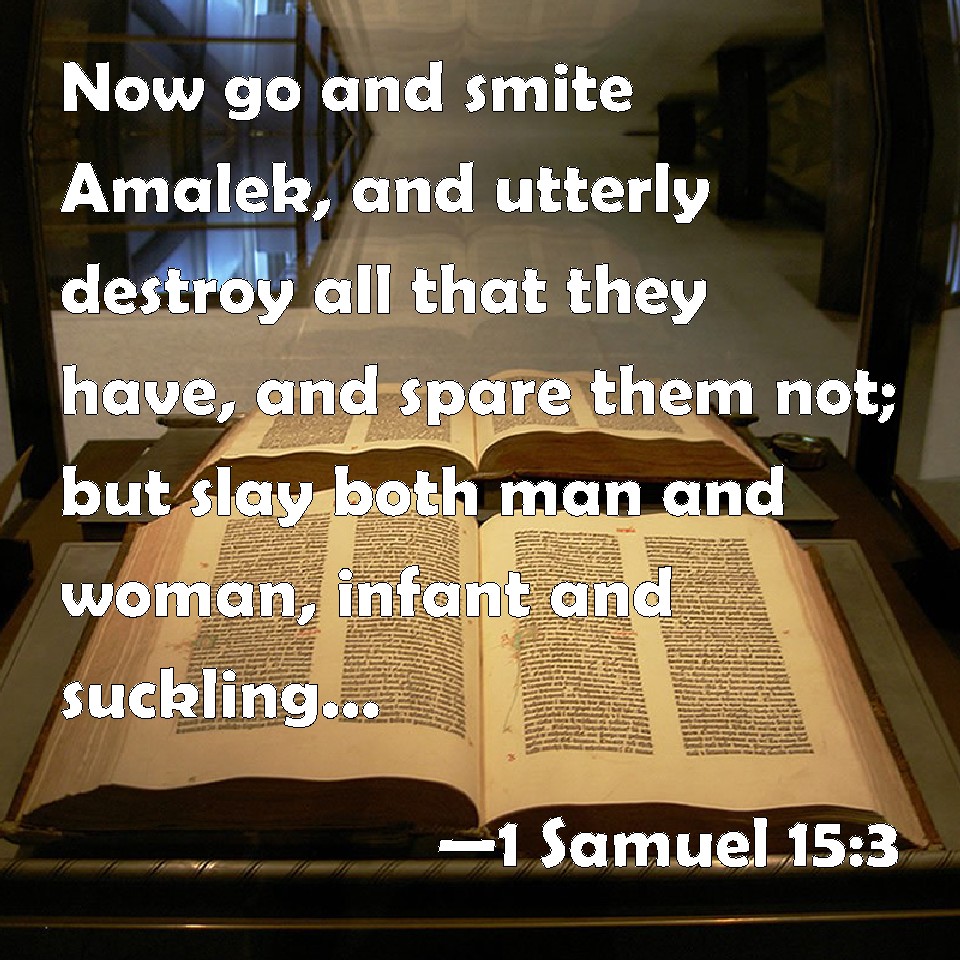
Is the Bible Immoral? Part 2: Did God Order a Genocide?

Now go and strike Amalek and utterly destroy all that he has, and do not spare him; but put to death both man and woman, child and infant, ox and sheep, camel and donkey. (1 Samuel 15:3)

As we consider critics' claims that the Bible is immoral, one of the most cited examples comes from 1 Samuel where God commands King Saul to destroy the city of Amalek along with everyone and everything in it. Critics typically use words like “genocide,” “atrocity,” and “infanticide” to describe the account. It's a clever use of loaded words to make God seem capricious.

Critics usually quote verse 3 out of context. 1 Samuel 15:2 says, “Thus says the LORD of hosts, ‘I will punish Amalek for what he did to Israel, how he set himself against him on the way while he was coming up from Egypt.” Critics don't include verse 2 because they intentionally want to omit God's motive for His command to Saul. Israel's encounters with Amalek began back in Exodus 17. After their flight from Egypt and during their wandering in the desert, the Jews were a nearly helpless people. They had no city, no walls, and no forts. They had to rely upon God daily for food and water. Deuteronomy 25:17-18 described it this way,

Remember what Amalek did to you along the way when you came out from Egypt, how he met you along the way and attacked among you all the stragglers at your rear when you were faint and weary; and he did not fear God.

At one point, while they were camped at Rephidim, the Amalekites came and attacked them. Moses told Joshua to lead armed men to resist the Amalekites and God gave the Jews the victory after a hard fought battle. Afterward, God made a promise to Moses:

Then the LORD said to Moses, “Write this in a book as a memorial and recite it to Joshua, that I will utterly blot out the memory of Amalek from under heaven.” Moses built an altar and named it, The LORD is My Banner; and he said, “The LORD has sworn; the LORD will have war against Amalek from generation to generation.” (Exodus 17:14-16)

God could have rained fire down on Amalek just as He had done with Sodom and Gomorrah, but it was many generations later, after the Jews settled in the Promised Land and Saul had become the king, that God fulfilled His promise.
So God's command to destroy the Amalekites wasn't arbitrary but rather was His judgment on that city for their crimes against Israel. Critics call the event “genocide” because that sounds more effective to their cause than calling it “justice.” Here's something that might put this into perspective: we need to consider the attitudes of Americans right after 9/11. Do you remember the calls that we should bomb Afghanistan and the Taliban back into the stone age? Were we interested in genocide or justice?

Of course, some people aren't satisfied with this explanation. Some have asked, “Why would God command the babies to be killed?” There are a couple of other points we need to keep in mind.

First, we have to remember that not only did all the people of Amalek die but Saul also died. Every one of Saul's soldiers died too. Every Jew in Israel died. Every prophet mentioned in the Old Testament has died. The Bible says that it is appointed unto a man to die and then he is judged (Hebrews 9:27). Some die old; some die young; some die violently; some die quietly. The mortality rate among people is 100%. Death has reigned since the Curse and just like it came to the Amalekites, it will also come to all of us. To say that God was cruel in His treatment of Amalek is to deny that God judges all of humanity fairly.

There is still another point we must consider, a point which relates to God as our Creator. Read this passage from Jeremiah:

Then [Jeremiah] went down to the potter’s house, and there he was, making something on the wheel. But the vessel that he was making of clay was spoiled in the hand of the potter; so he remade it into another vessel, as it pleased the potter to make. Then the word of the Lord came to [Jeremiah] saying, “Can I not, O house of Israel, deal with you as this potter does?” declares the Lord. “Behold, like the clay in the potter’s hand, so are you in My hand, O house of Israel.” (Jeremiah 18:3-6)

No one can credibly deny that the vessel a potter makes belongs to the potter. If the potter doesn't like how the vessel turns out, it is his right to scrap it and start over. In this haunting passage, we are reminded that we are created by God and so are subject to His will.


Words like “genocide” and “atrocity” are misleading characterizations of God. The Bible gives us a complete picture of Him. He is not a tyrant who smites innocents on a whim. He is not a pacifist who will shower grace on vile, unrepentant sinners. He is Holy and Just. We all face the same fate – a grave. We all have the same opportunity – eternal life through Jesus. I will have to stand before God and give an account for my sins; my only plea will be the shed blood of His Son. Critics are welcome to tell God He's not being fair.

Saturday, November 14, 2015

Is the Bible Immoral? Part 1

Some people criticize the Bible with the claim that it is immoral. That is, they believe the history recorded in the Bible and the commandments of the Mosaic Law offend our sense of right and wrong and so are evidence that the Bible is not the revelation of a good God. It's an excuse to not be a Christian or believe in God.

Critics who use this argument will also sometimes accuse Christians of picking and choosing which parts of the Bible we want to believe. If a Christian, for example, speaks out on the political issue of gay marriage, a critic might ask why doesn't the Christian also believe in executing homosexuals as commanded in Leviticus 20:13? This is an obvious attempt to undermine the Christian's credibility, claiming he appeals to the Bible when condemning homosexuality but ignores other parts of the Bible. If Christians feel we can ignore parts of the Bible with which we disagree, then how can we condemn the critic for doing the same?

Two of the most often cited examples of the Bible's immorality are probably God's command to the Israel army to kill the Amalekites (1 Samuel 15) and the Bible seeming to condone slavery (Leviticus 25:44-46, et al). I intend to discuss these two examples in more detail in my next two posts. In this post, I intend to discuss the weakness of these criticisms in general.

When responding to arguments like this, there are several points that should be kept in mind. The first, and probably the most significant, is to ask by what standard does the critic judge these acts to be “wrong”? If there were no God, then the universe is empty of morality. Everything that happens is nothing more than matter acting on matter. One man killing another is no more “evil” than a lion killing a zebra. When a person says it's “wrong” for God to command the Israelites to kill the Amalekites, it begs the question: wrong according to who? Obviously the Universe doesn't care what happens. The Israelites didn't believe it was wrong. What makes the critic's opinion on the subject the “correct” one? No one can call anything “wrong” without first acknowledging an absolute standard of right or wrong exists. There is no such standard in an impersonal universe. Objective morality exists only if God exists.

Moving on to my second point: We can see that the critic can't ever objectively say the Bible is wrong. At best, he can only say his sense of morality differs from how he understands the Bible. Ok, then what is the critic's point in raising this criticism? Is he trying to say there is no God because the Bible records things he finds offensive? You can see how that doesn't work. It would be sort of like me saying the Holocaust didn't happen because no dictator could be that cruel. This is a logic fallacy known as an argument from outrage.

Noted apologist for atheism, Richard Dawkins, wrote in his book, The Greatest Show on Earth, “Even if it were true that evolution, or the teaching of evolution, encouraged immorality that would not imply that the theory of evolution was false.” This is one of the few things on which Dawkins and I can agree. I would never try to attack evolution by saying Darwin was a racist. By that same token, though, someone claiming the Bible is immoral is not evidence that the Bible is not true.

We can see already that these criticisms of the Bible are built upon shaky foundations. Yet there are still a couple of more points we must consider. One thing is that God established the Law specifically for His people. When God established the Nation of Israel, it differed from other nations in that it did not have an earthly ruler – God was their ruler. The Jews lived their lives according to the Law and Judges were appointed to interpret the Law whenever a dispute arose.

Eventually, the people demanded to have a king like other nations. God relented and gave them Saul. Since then, we are subject to earthly rulers and laws during our lifetimes. The Law commanded that adulterers, for example, should be stoned. In the US, adulterers aren't executed but God is still the final Judge and someday we still must stand before Him to give an account for our sins. We are still judged according to the Law. However, the punishment for our sins is no longer necessarily at the hands of earthly rulers.

Finally, the Law was given to a fallen world. Some of the things it contains do not represent God's perfect will but rather are allowances God has made for sinful people who live in a corrupt world. Consider this passage from Mark 10:

And the Pharisees came to him, and asked him, Is it lawful for a man to put away his wife? tempting him. And he answered and said unto them, What did Moses command you? And they said, Moses suffered to write a bill of divorcement, and to put her away. And Jesus answered and said unto them, For the hardness of your heart he wrote you this precept. But from the beginning of the creation God made them male and female. For this cause shall a man leave his father and mother, and cleave to his wife; And they twain shall be one flesh: so then they are no more twain, but one flesh. What therefore God hath joined together, let not man put asunder. (Mark 10:2-9)

We see in this passage that when Jesus was asked about divorce, He explained that it was God's intentions that people never divorced. The Laws governing divorce were only written because of the hardness of our hearts. So even if the Bible seems to allow certain things, it does not necessarily mean the Bible “endorses” that thing.


I'll talk more about specific examples in my next couple of posts. For now, suffice it to say these are weak criticisms of the Bible.

Thursday, August 20, 2015

Answering the 10 Theological Questions That No Young-earth Creationist Can Answer: Part 4

7. Can you name any other piece of literature in which the existence of a talking snake and trees with magical powers would suggest to you that it was meant to be taken literally?

I've always been a little confused about the “talking snake” caricature people use to describe the Serpent in Genesis 3. Most people understand this is Satan, right? I mean, it wasn't just a garden variety snake talking to Eve – it was Lucifer. I'm not even sure he was in the form of a snake; he is merely being called a “serpent.” He is similarly described in Revelation 12:9, where he is again called that old “serpent”:

And the great dragon was cast out, that old serpent, called the Devil, and Satan, which deceiveth the whole world: he was cast out into the earth, and his angels were cast out with him.”

I'm entirely aware that most artistic renderings of Eve and the Serpent show a snake in a tree so maybe I'm at odds with many Christians. I just don't believe Satan appeared to Eve in the form of a “talking snake.”

Let's put all that aside for a moment. The question was, are there any other examples where talking animals are meant to be believed as real. Of course there are. In Norse mythology, Fenrir, the wolf, could talk. In Greek mythology, Arion, was a talking horse. In Hindu tradition, there was a man named, Kindama, who could assume animal form. There are also myriad examples of satyrs, fawns, and other woodland creatures which possessed varying degrees of human attributes but it always included speech. Of course, we know now that all of these creatures were mythical but they were believed to be real.

I'm sure the author was aware of these other examples because he says he, “just completed a survey of 6,842 stories that feature talking animals.” He follows up his point by saying, “none of them were history,” which, I believe, makes his point entirely non sequitur. What exactly is proved by his point? Is it that because Aesop wrote about talking animals, there can't really be talking animals? One doesn't necessarily follow the other. I could similarly say that Jesus didn't really turn water into wine because similar, miraculous feats (like King Midas turning anything he touched into gold) are all mythical. You can see how that doesn't really work.

Francke's entire premise in asking this question is a sort of argument of incredulity. He's trying to say that since these things might sound far fetched, they can't be true. I wonder if he would try the same thing with other “incredible” accounts from the Bible – like the Resurrection?

8. Why do Genesis 1 and 2 contradict?

The short answer is that Genesis 1 and 2 don't contradict each other. They are talking about different things. Genesis 1 describes the creation of the universe in six days and God's rest on the 7th day. This initial chronology – described in the King James as, “the generations of the heavens and the earth” - ends at Genesis 2:4. Genesis 2:5 begins an elaborate description of the creation of Adam and the Garden which occurred on day 6.

Now in Francke's defense, a lot of Christians don't get this – even some young-earth creationists. Why? I believe the passage if extremely clear. In fact, I cannot see how anybody doesn't get it. Yet, the confusion persists. It's very curious. I have a theory about why people miss what should be obvious. I believe the confusion exists precisely because people like Francke and other, old-earth Christians write commentaries that seek to “reconcile Genesis with science.” Worse yet, some theistic evolutionists, like Francke, probably understand the difference and intentionally hype the alleged contradictions in order to bolster their claim that the entire creation account is allegory.

In his criticism, Francke links to a Creation.com article that explains the seeming contradiction between Genesis 1 and 2. In that article, we find this quote:

It should be evident that chapter 2 is not just ‘another’ account of creation because chapter 2 says nothing about the creation of the heavens and the earth, the atmosphere, the seas, the land, the sun, the stars, the moon, the sea creatures, etc. Chapter 2 mentions only things directly relevant to the creation of Adam and Eve and their life in the garden God prepared specially for them.”

Francke has either not read the article to which he linked, has read it but doesn't understand it, or has read it but thinks that what Creation.com calls, “evident,” isn't really that evident. Of course, there is still the other possibility that he understands perfect well but is just flat out lying and continues to claim the chapters are contradictory in order to make a literal interpretation seem impossible.


Read the entire series:

Friday, March 6, 2015

Does the Bible say that Pi = 3?

And he made a molten sea, ten cubits from the one brim to the other: it was round all about, and his height was five cubits: and a line of thirty cubits did compass it round about. (1 Kings 7:23)

One of the very first criticisms I remember ever hearing about the Bible is that the Bible teaches that the value of pi is three. Critics who make this claim are referring to this passage from 1 Kings where the Bible is describing a large basin made for the Temple. I wasn't even a Christian when I first heard this claim but even then I thought it sounded a little weak. It wasn't until years later, though, that I began to look at the claim seriously.

The first thing you'll notice is that the passage doesn't really say, “Pi equals three.” In fact, the passages doesn't mention pi at all. I'm pretty sure that at the time this was written, pi had not even been discovered yet. What the passage does do is give the dimensions of a round object and it is from those measurements that people extrapolate backward to calculate pi.

If you remember high school geometry, the circumference of a circle is equal to its diameter times pi (c=dp). In this case, the circumference of the molten sea is 30 and its diameter is 10. So, 30/10 would be exactly 3 – a geometric impossibility. So does it mean the Bible is wrong? Of course it doesn't. There are at least two factors we must consider that aren't included in the text.

First, we do not know exactly what is being measured. For example, exactly what is meant by the word “brim”? I assume the walls of the vessel had a certain width. Is the diameter of the “brim” measured on the inside where the liquid is held or is it measured to the outside? If the diameter is measured on the inside and the circumference on the outside (which is entirely plausible) then we can actually use the measurements of each to determine how thick the walls were.

Knowing what is being measured is not as simple as you might think. Is the altitude of a plane a measure of its height from the ground? Or is it a measure of its height above sea level? Does a plane lose altitude every time it flies over a mountain? If a plane is about to land in Denver, is its altitude only a few feet or is still a mile up? In a drawn circle, the line around the circumference is assumed to have no width. But in reality, the sides of a real world vessel – like a drinking glass – have width. Was the diameter of the brazen sea measured on the inside of the walls or to the outside? It makes a difference.

But besides not knowing exactly where the “brim” was measured, we also cannot forget the very common and acceptable practice of approximating. For example, as I write this, I'm 49 years old. However, I'm not exactly 49 years old – I'm 49 years plus some months, days, hours, etc. My exact age changes by the minute but it's acceptable to only give the year.

We approximate many things. We only ever express our height in feet and inches but our exact height could fall somewhere between the inches. We express our weight in pounds when it is usually pounds plus some ounces. Our driving speed is given in miles per hour. We talk about our income in even thousands.

Even pi is an approximation. When I was in geometry class, we only expressed pi as 3.14. When I was in machine shop, we were always told to use pi to 5 places, 3.14159. But pi is infinitely long so it can never be exactly expressed. No matter how many decimal places you wrote, you are only approximating pi. It would even be correct to say pi is 3 because that's accurate to zero decimal places.

Given the fact that the Bible doesn't use decimal places, it's very likely that the dimensions given for the brazen sea were only approximates. If the diameter of the vessel was 9.68 cubits and the circumference were 30.4 cubits, it would be acceptable to round those to 10 and 30 cubits respectively. There would be no error. Claiming the Bible is wrong for using approximations is akin to calling everyone who expresses his age in years a liar.


For this criticism of the Bible to be valid, the critic must claim to have special knowledge of 2 things: First, he must know with certainty that the dimensions given for the diameter and circumference were both measured on the outside walls of the brazen vessel. He also must know with certainty that the measurements are intended to be exact and not approximations. He cannot possibly know that either is true. In fact, the opposite is more likely the truth in both cases. Which means that people who stubbornly cling to this criticism are liars.

Tuesday, January 27, 2015

Predestination: A Series on Election, Part 3 – Unconditional Election

The next point in Calvinism is Unconditional Election. This is really the meat and potatoes of Calvinism. It's the idea that God has already chosen who is going to be saved and who is going to be lost. The word “elect” in the Bible is always a reference to those who are saved. Unconditional election means that God has ordained the elect to be saved only according to His divine will and is not conditioned upon anything that we have done.

Of the five points, this one probably has the most compelling Scriptural support. There are several passages that can be used to support the idea of election but the following are perhaps the most persuasive:

Ephesians 1:4-5, 11, “just as He chose us in Him before the foundation of the world, that we would be holy and blameless before Him. In love He predestined us to adoption as sons through Jesus Christ to Himself,according to the kind intention of His will..... also we have obtained an inheritance, having been predestined according to His purpose who works all things after the counsel of His will.”

Romans 9:10-16, “Not only that, but Rebekah’s children were conceived at the same time by our father Isaac. Yet, before the twins were born or had done anything good or bad—in order that God’s purpose in election might stand: not by works but by him who calls—she was told, “The older will serve the younger.” Just as it is written: “Jacob I loved, but Esau I hated.” What then shall we say? Is God unjust? Not at all! For he says to Moses,“I will have mercy on whom I have mercy, and I will have compassion on whom I have compassion.” It does not, therefore, depend on human desire or effort, but on God’s mercy.”

What I find especially interesting is Paul's letter to the Romans, when he says that God loved Jacob above Esau even “before the twins were born or had done anything good or bad.” At first hearing, it seems a clear cut example of God simply choosing one person over another. Jacob certainly had not done anything before he was born to earn God's favor so he received God's mercy unconditionally. Yet as clear cut as it might seem, we must still consider these passages in the light of the rest of Scripture. Look at the following passages:

1 Timothy 2:3-4, The Lord is not slow about His promise, as some count slowness, but is patient toward you, not wishing for any to perish but for all to come to repentance.

Acts 17:30, The times of ignorance God overlooked, but now he commands all people everywhere to repent,

If God has already ordained that only some people will be saved and the others lost, how can He simultaneously not want anyone to perish? Perhaps it is because God is omniscient and already knows who will accept Him and who will not. Peter said that he was elect, “according to the foreknowledge of God” (1 Peter 1:1-2). It could be that God elects those He knows will believe and makes plans for them even before they are born.


God is not capricious. Because of His love and mercy, He has made salvation available to everyone; but because He is also just and holy, He has laid out a very clear method of redemption. God will have mercy upon whoever believes in His Son – even the most vile sinner.

Saturday, January 24, 2015

Predestination: A Series on Election, Part 2 – The Total Depravity of Man

As I discussed in my last post, the 5 points of Calvinism are summarized with the acronym, TULIP. The letters stand for:
  • Total depravity of man
  • Unconditional election
  • Limited atonement
  • Irresistible grace
  • Preservation of the saints
Fundamental to Calvinism is the idea that mankind is totally depraved. He is a hopeless sinner who is not only completely unable to do good works but also lacks even the desire to do good. Therefore, a man is totally without any power to even call on God to save him. According to Calvinism, a man lacks the ability or desire to be saved in the same way a dead person lacks the ability or desire to come out of the grave. It's impossible.

There are some verses in the Bible that support this concept:

John 6:63, It is the spirit that quickeneth; the flesh profiteth nothing

Romans 3:10-11, as it is written, “There is none righteous, not even one; There is none who understands, There is none who seeks for God.” (Paul is paraphrasing Psalm 14)

Jeremiah 17:9, “The heart is more deceitful than all else And is desperately sick; Who can understand it?”

John 6:44, No one can come to Me unless the Father who sent Me draws him; and I will raise him up on the last day.

If I read only these verses and nothing else in the Bible, I would have to agree 100% that a man could not and would not come to God by his own will. However, there are other verses that we must consider.

Joshua 24:15, “If it is disagreeable in your sight to serve the Lord, choose for yourselves today whom you will serve: whether the gods which your fathers served which were beyond the River, or the gods of the Amorites in whose land you are living; but as for me and my house, we will serve the Lord.”

1 Kings 18:21, “Elijah came near to all the people and said, “How long will you hesitate between two opinions? If the Lord is God, follow Him; but if Baal, follow him.””

Isaiah 1:18, ““Come now, and let us reason together,” Says the Lord, “Though your sins are as scarlet, They will be as white as snow; Though they are red like crimson, They will be like wool.”

As clearly as the first passages seemed to say we are unable to come to God, these other passages seem clearly seem to say we have a choice. I admit that it seems to be a dilemma. I think the key to understanding all verses in harmony hinges on the realization that God is sovereign but even the sovereignty of God is a difficult subject to grasp.

My point here is not to establish which verses are “correct.” The fact of the matter is that all the verses are correct. Neither am I trying to suggest what is the more likely understanding. Like I've already said, I only intend to discuss the different points of view. As we can see, Scriptural support for either view can be found. It would be rather narrow minded of us to cling dogmatically to one or the other and “explain away” the opposing verses. A better course of action would be to trust that God is loving, merciful, and just and know that He will always do what is right.


We need to simply trust in Jesus as our Savior without worrying about whether or not we were predestined to do so.

Friday, January 23, 2015

Predestination: A Series on Election, Part 1

God is sovereign. He controls everything – big and small. Proverbs 16:33 says, “The lot is cast into the lap, But its every decision is from the Lord.” A bird does not fly, a leaf does not fall, and a man does not take a step except that it should be the will of God. However, this begs the question: if our every action is subject to God's will, how then can we be held accountable for our sins? Does that mean a lost person was ordained to be lost or a saved person ordained to be saved? This is not a new question but one that has raged for centuries. I guess there are a lot of different nuances concerning the idea of predestination but there are basically two schools of thought: Calvinism and Arminianism.

Calvinism is named for John Calvin, a 16th century, French theologian. He argued that people are “pre-destined” to be either saved or lost. Actually, the idea of predestination preceded Calvin by centuries but he codified the idea into five, succinct points, often referred to by the acronym, “TULIP.” He argued so successfully that his name has become synonymous with predestination.

Almost immediately after Calvin lived, a Dutch theologian named Jacob Arminius began arguing that man, though sinful, still has a free will and can choose to accept or reject Christ. His idea of “free will” is identified by the term, Arminianism. His views became very popular but still remained the minority view in the church until the time of John Wesley in the 18th century. Today, most protestant churches would identify themselves as believing in free will or Arminianism.

There are certain matters of doctrine that are critical to orthodoxy. For example, I do not believe anyone can be a Christian unless he believes in a literal, physical resurrection. Other matters are trivial, like whether or not the wine Jesus made at the wedding in Cana (John, chapter 2) was alcoholic or not. In my opinion, the difference between Calvinism or Arminianism falls into the trivial category. If a person confesses Jesus as his Savior, what difference does it truly make if he did it of his own free will or if he had been predestined to do it? I'm certainly not going to challenge his profession of faith over it. Unfortunately, many churches do argue over it.

I thought it would be interesting to have a short series discussing the issue. I don't intend to endorse one view over the other (though I do have my personal opinions). Instead, I want to simply present the Scriptural arguments for and against the five points of Calvinism. I want it to be more informative in nature rather than persuasive. Perhaps the only thing I would like to persuade people of is that they may see the issue in the same, non-constroversial light that I see it.


Please check back.